At this point, I feel like making sure I'm successful on the GLP meds is my job. I'm thinking about it most of the time. I'm experimenting with foods, I'm checking in on my body, I'm getting up and moving around after I eat and the stomach is full. I'm reading everything I can find. Of course, making sure what I'm reading is from a reputable source is always an issue, especially since much of the information comes via social media or AI.
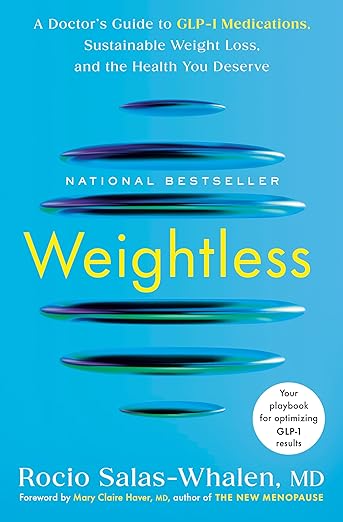 |
| Weightless by Rocio Salas-Whalen |
This book was recommended by a chat group on the WW app. It came out in December of last year, so it's quite up-to-date. I consider myself well informed about GLP meds, but I learned a lot from this book. I listened to it - 9 hours over the course of a week - as if it were a novel. I found it so useful that I've now ordered it to get a hard copy delivered. I love to listen to books, both fiction and non-fiction, but the listening format makes it very hard to go back and reference something. Even ebooks sometimes make it harder to look things up. I am a huge ebook and audio book fan, but if I'm going to be flipping back and forth through a book I prefer to have a hard copy in my hands.
The author has been a long term specialist in obesity medicine. This book is soup to nuts, from the history of obesity treatments and the development of GLP meds, to current options, what to expect, how to handle issues, and what to expect and options for handling maintenance. And like every self-improvement book you've ever read, individual stories: "Carol was frustrated. She came to me because....".
She frames how to think about being on the meds as "creating a helpful environment for you to make the changes that will sustain you for the long term". In other words, the drugs don't do it, you do. And that takes work.
Here are some things that stuck out for me as I listened, that I want to go back and read more and study more. She is a fanatic on preserving muscle by eating protein and working out. She wants people to think of what we are doing is less about weight loss and more about "body recomposition". By this she means shifting the ratio of fat to muscle in our bodies. In her view, body composition analysis is how to determine if the process has been successful for you, not the scale readings.
She writes about resistance and weight training, which I'm on top of. But she sets really high targets for the daily protein intake - for everybody, all ages and sexes, an absolute bare minimum of 100 grams of protein a day. This is significantly higher than the 83 gram minimum WW sets for me. I am close to that WW minimum almost every day, but raising it to 100 grams will be really hard. She is a big fan of whey protein powder, which I'm not ready to embrace. She suggests the best way to make the protein target is to add whey powder to everything, from your morning coffee (not gonna happen) to sprinkling on other meals, and also a shake/smoothie. (I'm not sure why I'm so reluctant to try the whey powder - I think besides my aversion to frankenfoods I'm afraid of aftertastes. But maybe I should experiment. At Whole Foods, I found an entire section full of different kinds of whey powder. So maybe? But not in my sacred morning black coffee!)
She also asserts that our bodies generally don't absorb more than 30 grams of protein at a single meal, and so making the 100 gram target would require three hefty meals and a hefty snack, or some pattern of spreading it out through the day. I have a long history of not feeling hungry in the morning, and working out first thing on an empty stomach. But if I'm going to get all the right eating in, I need to start early. I have to eat smaller meals, and I want to finish big eating a few hours before bedtime. So I've tried grabbing a lowfat cottage cheese (19 grams protein) directly I get up. I've tried to restrict myself to only a couple of (plant-based) protein shakes a week, so far after working out, because they are definitely a frankenfood (ultra-processed). But they are very convenient, from 20-30 grams of protein, and fairly palatable. I have been adding some ground flaxseed to meals where it is easily disguised - tasteless to me, not gummy like chia seeds, but some impact on texture and looks. I cook my rice and pasta in bone broth. My latest try - using my girl's vegan hack for parmesan - nutritional yeast, found next to whey protein in the supplements aisle. (I read the label for plant-based "parmesan" in the vegan case at the store - 0 grams protein and 0 grams fiber. Must be made from petroleum?) Results are not yet assessed on the nutritional yeast.
The one disturbing (to me) thread throughout the book is how the author assumes losing weight is everyone's goal. (Though only with preserving muscle, not skinny only.) If she talks about body positivity, inclusiveness, and health at every size (HAES), I missed it or it didn't stick with me (another reason to have a hard copy to look at). Intuitive eating didn't work for me, but I've spent years coming to terms with how I look and feel. I don't hate my body now. I am quite healthy, and don't have co-morbidities from my obesity. But still, HAES is about being as healthy as you can in the body you have now. There are health impacts from obesity, and losing weight fixes many of them. But there are even more social impacts, and I hate that that is true and I think it's wrong. But still, I would like to look better in nice clothes.
I've thought about this, and the fact that no everyone who wants it actually has access to the drugs is not a reason for me to not take them. My not doing this, as an individual action, helps no-one. The fact not everyone wants to, or can, take them is also not a reason for me to stay away. I support those who are happy with the way things are, or choose a different path for whatever reason. But I'm still doing it.


2 comments:
Such a thoughtful post, Nan, thank you!
Love you found a reference that feels really sound. To the extent this new book is an outgrowth of weird values, it’s still growth, options are good. Yyou do way more on the other side of the ledger- creating a world with better values around weight- than any hypothetical support of the weirder values by buying a book. This post is more convoluted than ideal, but you are the change we want to see in the world so much more than anything else. And what you do to be strong and healthy so you can be more change, well, there’s nothing but good there.
Liz
Post a Comment